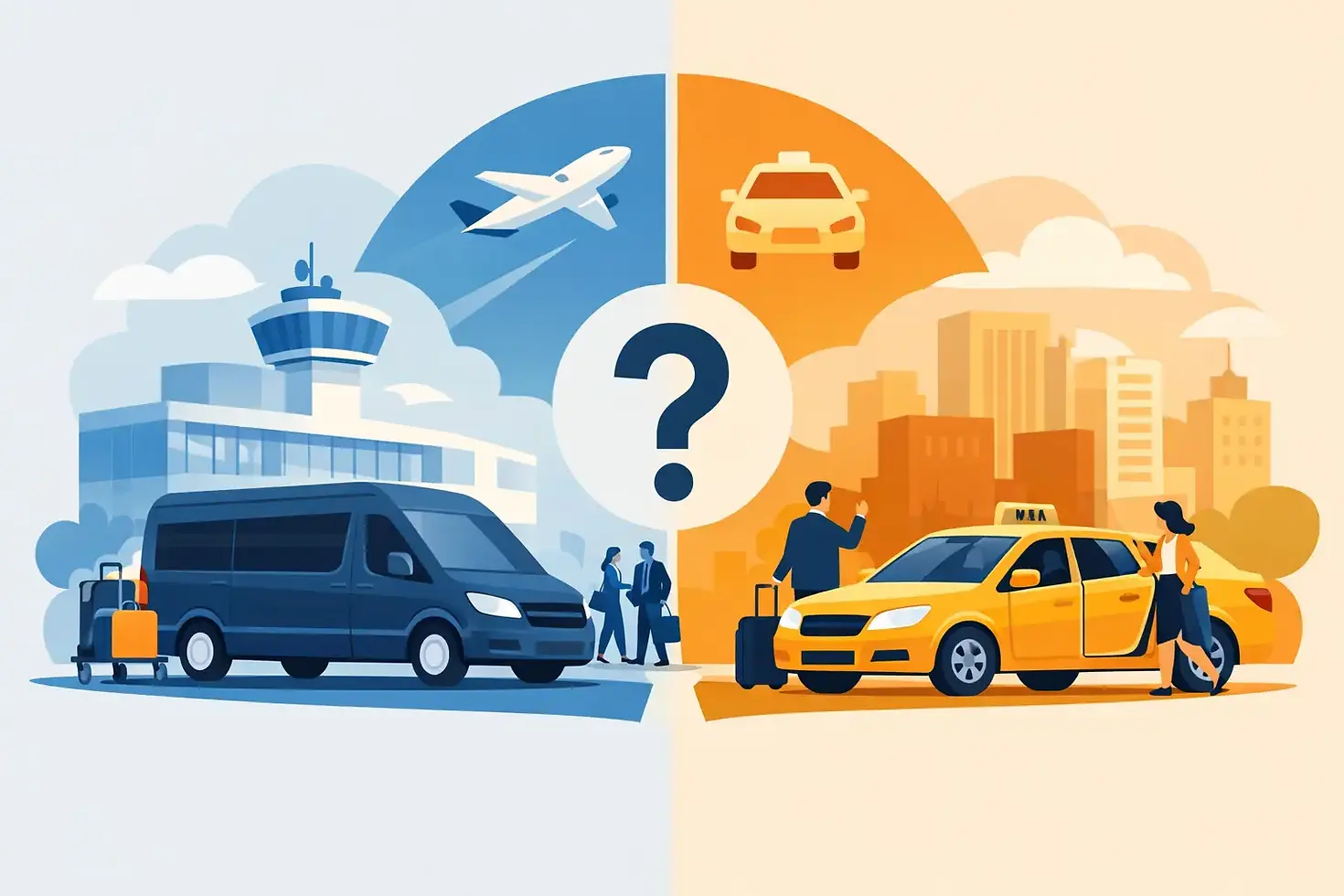
Airport Transfer Versus Taxi: Which Fits?

Landing at the airport with a tight meeting schedule, tired children, or a VIP guest waiting at arrivals is usually when the difference between airport transfer versus taxi becomes very real. On paper, both get you from the terminal to your destination. In practice, the gap shows up in timing, vehicle standards, luggage handling, pricing clarity, and how much coordination you need to do yourself.
For some trips, a regular taxi is perfectly reasonable. For others, especially when punctuality and presentation matter, a pre-booked airport transfer is the stronger choice. The right option depends on what kind of traveler you are, how fixed your schedule is, and how much risk you can tolerate on arrival day.
Airport transfer versus taxi: the core difference
A taxi is usually an on-demand ride. You land, head to the taxi stand or book through an app, and take whichever vehicle is available. That model works well when your only requirement is basic transport and you are comfortable with some variability.
An airport transfer is booked in advance for a specific arrival or departure. The vehicle type is typically confirmed ahead of time, the pickup is scheduled around your flight, and the service is designed around predictability rather than simple availability. In a premium executive setting, that often also includes a professional chauffeur, meet-and-greet support, luggage assistance, and a more polished travel experience.
That distinction matters because airport transportation is rarely just transportation. It is often the first operational step after a flight, and small delays can affect meetings, hotel check-ins, events, and onward connections.
When a taxi makes sense
Taxis still have a clear place. If you are traveling alone, carrying light luggage, heading to a nearby destination, and your timing is flexible, a taxi can be efficient. You do not need to plan ahead much, and in many cities there is enough supply to keep waiting time reasonable.
A taxi can also suit casual leisure travel where the ride itself is not a priority. If there is no client waiting, no event check-in window, and no need to manage a group, convenience may matter more than consistency.
The trade-off is that convenience is conditional. It depends on queue length, vehicle availability, time of day, weather, local demand, and whether the car you get is truly suitable for your luggage or passenger count. For a simple trip, that may be acceptable. For a high-stakes arrival, it often is not.
When an airport transfer is the better option
Pre-booked airport transfers are built for travelers who value control. If your flight lands late at night, if you need a larger vehicle, if you are coordinating for an executive or family, or if your schedule leaves little room for error, advance booking removes a lot of uncertainty.
The most obvious advantage is planning. You know what has been reserved, who is meeting you, and what class of vehicle will arrive. That matters for corporate travelers, executive assistants, event organizers, and anyone handling a guest experience rather than just their own commute.
A premium airport transfer also reduces friction after landing. Instead of joining a queue and hoping the next available vehicle fits the job, you move into a service already aligned with your timing and requirements. That can be the difference between a calm arrival and a rushed one.
Pricing is not just about the headline fare
Many travelers compare airport transfer versus taxi by looking only at the starting price. That is understandable, but it is not always the most useful comparison.
Taxi pricing can look lower upfront, especially for short rides. But the final fare may shift based on traffic, surcharges, peak periods, airport fees, route changes, or waiting time. That does not automatically make taxis expensive. It does mean the final number can be less predictable.
Airport transfers tend to be valued differently. You are not only paying for the vehicle moving from one point to another. You are paying for reservation certainty, professional coordination, the correct vehicle class, and time-sensitive service built around your flight. For business travel or formal guest handling, those details often justify the premium.
For budget-sensitive personal trips, a taxi may still win on raw cost. For business use, group travel, or VIP movement, cost should be weighed against delays, presentation, and coordination workload.
Reliability matters more than most travelers expect
Reliability tends to be the deciding factor. A taxi system can be efficient overall and still feel inconsistent on the day you need it most. Long queues, peak-hour shortages, or uncertainty around vehicle type can create avoidable stress.
Airport transfers are generally stronger where timing is fixed. If you have a board meeting, a cruise departure, a hotel check-in window, or an elderly family member arriving, reliability becomes operational rather than optional. In those situations, the best transport choice is the one that reduces variables.
This is why executive travelers often prefer pre-arranged service. They are not simply buying a ride. They are buying confidence that the arrival or departure plan will hold.
Vehicle quality and comfort are not a small detail
Not every traveler needs a premium cabin. But comfort becomes more relevant after a long-haul flight, during family travel, or when the passenger is a client or senior executive.
With a taxi, vehicle quality can vary. Some rides are perfectly fine. Others may feel too compact for luggage, less private than expected, or simply not aligned with the standard the trip requires.
An airport transfer allows you to match the vehicle to the occasion. That could mean a premium sedan for a solo executive, a luxury MPV for family airport pickups, or a larger executive vehicle for a delegation. The benefit is not only comfort. It is suitability. A properly matched vehicle prevents the common airport problem of trying to fit the wrong number of people and bags into the wrong car.
Group travel changes the equation
This is where taxis often become inefficient. If you are moving a family with multiple suitcases, a business team, or event attendees, booking several taxis can create fragmented arrivals, inconsistent costs, and communication issues.
A dedicated airport transfer is usually better for groups because everyone moves on one coordinated plan. The luggage space is considered in advance, the pickup timing is unified, and there is one point of accountability. For conferences, weddings, corporate delegations, and private tours, that level of organization is hard to replace with ad hoc rides.
In Singapore especially, where many arrivals are business-related and time-sensitive, coordinated airport transport is often the cleaner solution. That is one reason premium operators such as GOEXEC SG position airport transfers as part of a broader executive mobility service rather than a simple one-off ride.
Privacy, service, and presentation
Some transport decisions are practical. Others are also about image and service standards.
If you are receiving a client, senior leadership guest, speaker, or private traveler who expects discretion, an airport transfer is usually the better fit. The chauffeur service model is designed to support privacy, polished presentation, and direct passenger assistance. That matters when the journey is part of the guest experience.
A taxi is transactional by design. There is nothing wrong with that. But it is not usually built to deliver a premium arrival impression. If the ride is the first touchpoint in a business relationship or event itinerary, the details carry more weight.
Which option fits your trip?
If your trip is simple, flexible, and cost-led, a taxi may be enough. If your trip is scheduled, high-value, group-based, or presentation-sensitive, a pre-booked airport transfer is usually the smarter choice.
The easiest way to decide is to ask what happens if the ride is not ideal. If the answer is very little, a taxi is fine. If the answer is a missed meeting, a poor guest experience, confusion at arrivals, or unnecessary stress, then the premium for an airport transfer is often money well spent.
That is the real answer to airport transfer versus taxi. It is not about which option is universally better. It is about which one gives you the right level of certainty for the trip in front of you.
When timing is tight and expectations are high, transportation should feel settled before the flight even lands. That peace of mind is often the part travelers value most once they arrive.



Comments