
How Airport Limousine Pickups Work

You land after a long flight, clear immigration, collect your bags, and the last thing you want is confusion at the curb. That is exactly why many travelers ask how airport limousine pickups work before they book. For business arrivals, family travel, VIP guests, and corporate delegations, the value is not only the vehicle - it is the planning, timing, and professional handoff from airport to destination.
An airport limousine pickup is a pre-arranged chauffeur service designed around your arrival details. Unlike a standard ride request made after landing, the service is organized in advance, tied to your flight information, and managed with a professional pickup process. The result is a more controlled arrival, especially when timing, presentation, and reliability matter.
How airport limousine pickups work from booking to arrival
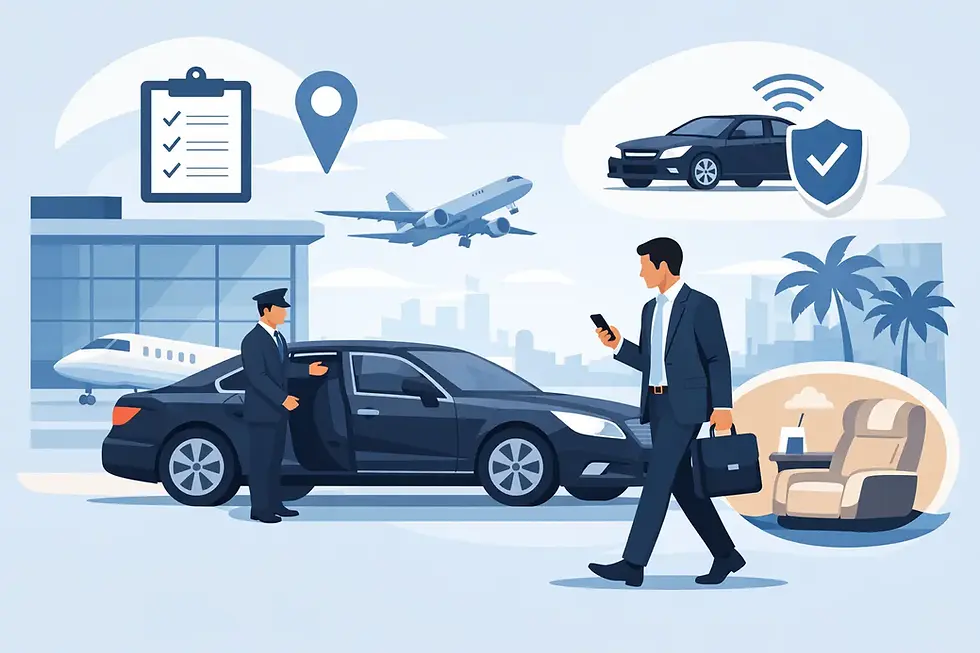
The process starts before the aircraft leaves the gate. When you make a reservation, the provider typically asks for your full name, arrival date, flight number, landing time, terminal, destination, number of passengers, and baggage count. If you are booking for a corporate traveler or group, vehicle size and any special handling requirements are confirmed at the same time.
This early coordination matters because the right airport transfer is not only about sending a car. A solo executive with one carry-on has different needs than a family with strollers or a delegation carrying presentation equipment. Premium providers match the vehicle to the movement, whether that means an executive sedan, a luxury MPV, a Mercedes-Benz V-Class, or a larger people mover.
Once the booking is confirmed, your trip is usually assigned to a chauffeur with the relevant dispatch details. In a well-run operation, the chauffeur is briefed on the pickup time, terminal, flight status, destination, and service notes. That sounds simple, but it is where premium service separates itself from last-minute transport options. A polished arrival depends on preparation.
Flight tracking is a big part of how airport limousine pickups work
One of the main differences between a limousine airport transfer and a standard pickup is flight monitoring. Professional chauffeur services usually track your incoming flight so the pickup adjusts if your aircraft lands early or late. That reduces the need for repeated calls and prevents the common problem of a vehicle arriving too soon or not being there when you exit.
Flight tracking is especially useful on international routes, where delays are common and arrival times can shift by 20 minutes or several hours. For the traveler, that means less coordination during an already tiring part of the journey. For executive assistants and event planners, it means fewer moving parts to manage.
There is a practical limit, though. Flight tracking helps with airborne timing, but it does not eliminate every variable on the ground. Immigration lines, delayed baggage, oversized luggage collection, and customs checks can still add time. That is why reputable providers build in waiting policies and communicate clearly about grace periods and extra waiting charges if they apply.
Meet-and-greet vs curbside pickup
Not every airport limousine pickup works the same way once you land. The two most common arrangements are meet-and-greet service and curbside pickup.
With meet-and-greet, the chauffeur or an airport greeter waits inside the arrivals area with a name sign. This is usually the preferred option for VIP travelers, first-time visitors, families, and anyone who wants the simplest possible handoff. After making contact, the chauffeur assists with baggage and escorts the passenger to the vehicle pickup point.
Curbside pickup is more direct. The passenger exits the terminal and meets the chauffeur at a designated lane or collection point. This can work well for travelers who know the airport layout and want a faster exit, but it depends on clear communication. Busy airports often have strict curbside rules, so timing has to be precise.
The better choice depends on the traveler. A senior executive arriving for meetings may prefer meet-and-greet for privacy and efficiency. A frequent flyer traveling light may be perfectly comfortable with curbside collection. Neither option is universally better - it depends on the airport, the passenger profile, and the level of assistance required.
What happens after you land
After the aircraft arrives, the chauffeur service follows a basic sequence. Your flight is checked, your arrival status is confirmed, and the chauffeur is positioned based on the agreed pickup method. If the service includes meet-and-greet, the passenger is received inside the terminal. If it is curbside, the chauffeur coordinates by message or call once the traveler is ready to exit.
At this stage, professional communication makes a noticeable difference. Travelers should receive the chauffeur's contact details, vehicle details, or pickup instructions before landing or shortly after arrival. For corporate bookers, this reduces uncertainty for the passenger and cuts down on coordination requests.
Once the passenger and chauffeur connect, baggage is loaded and the transfer begins. In premium service, this part should feel efficient and composed. No searching for the car, no fare negotiation, and no uncertainty about route or destination.
Waiting time, parking, and airport rules
A common source of confusion is waiting time. Many travelers assume a chauffeur can simply stand wherever convenient until they walk out. In reality, airport pickups are shaped by parking controls, commercial vehicle access rules, and terminal enforcement.
That means your chauffeur may be waiting in a staging area, short-term parking facility, or designated commercial pickup zone until your flight and exit timing line up. This is normal. It does not mean the driver is late. It often means the service is following airport procedures correctly.
Waiting time policies vary by provider. Some include a fixed grace period after landing. Others count waiting time from actual touchdown, while some begin after a flight-adjusted arrival time. This is worth checking in advance, especially for travelers arriving on long-haul flights who may take extra time at immigration.
Vehicle choice affects the pickup experience
When people think about how airport limousine pickups work, they often focus on the chauffeur and overlook the vehicle plan. But vehicle choice has a direct impact on comfort, luggage handling, and overall efficiency.
An executive sedan may be ideal for one or two passengers with light baggage. A luxury MPV or V-Class is often better for travelers who want more cabin space, easier entry, or room for multiple suitcases. For families, event teams, and corporate groups, larger vans or buses may be necessary to keep everyone on one coordinated schedule.
Choosing too small a vehicle creates delays at the curb and discomfort on the road. Choosing too large a vehicle can be less efficient on cost. A professional booking team should ask enough questions to get this right before the day of travel.
Why business travelers and VIPs choose limousine pickups
The main reason is control. A limousine pickup is built to reduce uncertainty at a point in the journey where delays, fatigue, and poor coordination are common. For corporate travelers, it protects schedules. For executive assistants, it reduces follow-up. For VIP guests, it supports privacy, presentation, and a higher service standard.
There is also a brand element. When a company arranges a polished airport arrival for a client, speaker, investor, or senior hire, transportation becomes part of the professional impression. That does not mean every traveler needs the highest-end option. It means the service level should match the importance of the arrival.
In a market like Singapore, where efficiency and timing are closely watched, this matters even more. GOEXEC SG, for example, positions its airport transfer service around punctual chauffeur support, transparent rates, and fast WhatsApp booking confirmation - exactly the kind of straightforward coordination many travelers and assistants want.
How to make your airport pickup go smoothly
The easiest way to avoid problems is to provide complete booking details from the start. Share the correct flight number, passenger name, terminal if known, destination, baggage count, and contact number that will be active on arrival. If someone else is booking for you, make sure the passenger receives the chauffeur details too.
It also helps to confirm the pickup style in advance. If you want a signboard inside arrivals, ask for meet-and-greet. If you prefer to exit quickly and meet outside, confirm the exact collection point. Small details prevent most airport pickup issues.
Finally, book with a provider that communicates clearly. Premium transport should feel efficient before the trip even begins. If pricing is vague, response times are slow, or pickup instructions are unclear during booking, that usually does not improve on arrival.
The best airport limousine pickup is not dramatic. You land, your chauffeur is where you expect, your bags are handled, and you leave the airport without friction. For travelers who value time, presentation, and reliability, that quiet efficiency is the whole point.


Comments